Replacing McQuay PTAC Units in New York
New York put up more postwar apartment towers than any city in the country, and many of them went in with McQuay, Singer, or Remington through-the-wall units. McQuay, now Daikin Applied, stopped building PTACs in 2014. The towers are still standing. When a unit dies, a replacement chassis built to the original McQuay sleeve goes into the same wall opening, connects to the same hot water lines, and leaves the facade alone.
Read the McQuay nameplate to 800-866-1210 and we match it.
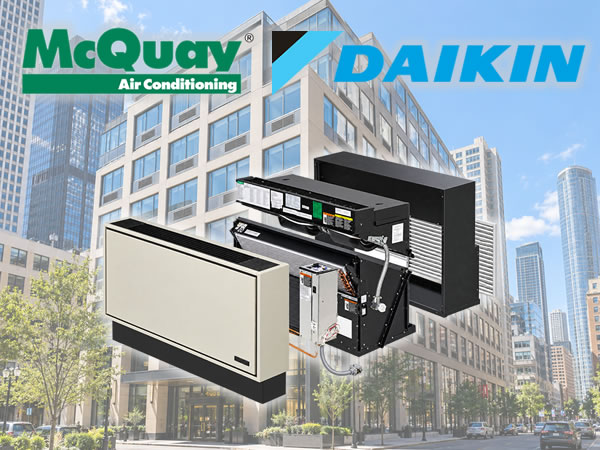
Why McQuay units are still all over the city
For more than 50 years McQuay sold through-the-wall units under the McQuay, Singer, Remington, and Climate Control names. Developers of 1960s and 1970s co-op complexes, Mitchell-Lama buildings, and rental towers bought them by the thousand. Many of those buildings heat from a central boiler, and the McQuay units carried a hot water coil fed by that boiler.
That history leaves New York with two problems a standard PTAC does not solve:
- The sleeves are not 42 x 16. McQuay used several widths, including 42 and 44 inch sleeves, and three-piece K series installations with no single sleeve. A current GE Zoneline does not fit.
- The heat comes from the boiler. Swap a hydronic unit for an electric one and the room stops heating from the building plant. In a rental, that shifts heating cost and raises questions about meeting the city's heat requirements.
Applied Comfort builds replacement chassis to the dimensions of discontinued McQuay series, with the hot water coil in the matching position. Air Distributors has supplied McQuay replacements since the line ended.
McQuay replacement at a glance
- Original brands
- McQuay, Singer, Remington, AAF
- Series often found in New York
- PNES, ENH, Series 16, PDAE, PMES, MEA, EA, PKES, MEK, K, PDHE, PMRS, RS, J
- Replacement
- Applied Comfort chassis built to the original sleeve
- Heat
- Hot water coil, electric heat, or heat pump
- McQuay on 42 x 16
- Applied Comfort NA, NF, or NY series, or GE Zoneline when the room heats electrically
Two paths, one usually wins
Replace the chassis only
The new chassis slides into the existing McQuay sleeve and uses the existing louver. No masonry, no scaffolding, no facade change, no Landmarks filing for the louver, and no board debate about what the building looks like from the street. The room is back in service the same day. For an occupied co-op or rental, this is the practical choice.
Rebuild the opening for 42 x 16
The wall gets cut or rebuilt for a standard sleeve and a new louver. That opens up more unit choices in the future. The cost: masonry work, permits, possible Landmarks review, board approval, noise and dust in an occupied apartment, and a room out of service for days. This path makes sense during a gut renovation, when the walls are open anyway.
Hot water coils: top or bottom
Most McQuay units in New York carry a hot water coil. Before you order, look under or above the chassis for the supply and return pipes.
- Note whether the pipes connect at the top or the bottom of the unit. The replacement keeps the same position so the piping lines up.
- Note the valve type, if there is one, and whether the building controls the boiler loop centrally.
- Check for leaks and corrosion at the connections. A replacement is the time to fix a weeping valve, before it becomes a ceiling claim downstairs.
- If the unit has no pipes, it heats with electricity. The nameplate shows heater kW or a heat pump rating.
Electrical and controls
- Read the voltage on the McQuay nameplate. Many towers run 265V to the units, often hardwired.
- Note the breaker size. Electric heat output depends on it.
- Look for a wall thermostat. Some McQuay installations used a remote 24V thermostat. The replacement is set up for it if you tell us.
- On hydronic units, the electrical load is mostly the compressor and fan. Note it anyway so the chassis matches the circuit.
Buildings that call about McQuay units
Large developments in the Bronx, Queens, and Brooklyn where hundreds of rooms share the same McQuay sleeve.
Manhattan and outer-borough towers where owners pay for heat through the boiler.
Fort Lee, Cliffside Park, and Edgewater towers from the same era.
Resident rooms where cutting a wall is not an option.
What to send for a McQuay quote
- Full model number from the McQuay, Singer, or Remington nameplate
- Sleeve width, height, and depth, measured inside the sleeve
- Voltage, amperage, and plug-in or hardwired
- Heat type, and for hot water coils, top or bottom connections
- How many units are failed now and how many are still running
Plan lead time
McQuay replacement chassis are often built to order. Keep one or two spares in the basement shop so a January failure does not leave an apartment without heat while a unit is built. Units ship from Louisville, Kentucky, or direct from Applied Comfort.
Quote a McQuay ReplacementRead more: replacing discontinued McQuay units, how Applied Comfort fits non-standard sleeves, and PTAC replacement in co-ops and condos.
Need a replacement PTAC for a New York building?
Send the old model number, the sleeve size, voltage, heat source, quantity, and your building's delivery rules. A factory-authorized distributor replies with a quote, lead time, and freight to your door anywhere in the metro.