GE Zoneline PTAC Units for New York Buildings
Walk into a Midtown hotel room, a Long Island City rental, or a Jersey City condo and the unit under the window is often a GE Zoneline. If your building has 42 x 16 sleeves, a current Zoneline chassis slides into the opening you have. The louver on the facade stays. The co-op board and Landmarks never see a change.
Have the old nameplate in hand? Call 800-866-1210.
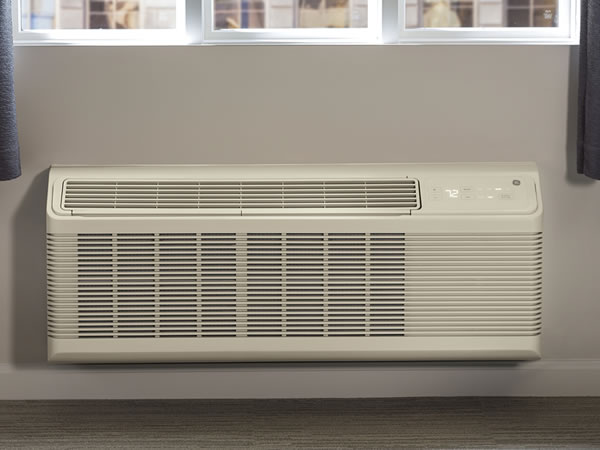
Where Zoneline fits in the New York market
Zoneline is the default choice when three things are true: the sleeve is 42 x 16, the room heats with electricity, and you want a unit that service techs across the five boroughs already know.
- Hotels in Manhattan, the airport corridors, and the Meadowlands. Guest rooms run near full occupancy, so a matched replacement model across every floor keeps spare-parts stock simple.
- Rental towers built since the 1990s. Downtown Brooklyn, Long Island City, the Jersey City waterfront, and White Plains towers often carry Zoneline or another 42 x 16 brand in every apartment.
- Condos and co-ops where the owner replaces the unit. A shareholder or unit owner wants a swap that needs no wall work and no board fight.
- Mechanical contractors and managing agents who need one current model they can order again next year.
Zoneline is the wrong fit for a non-standard sleeve or for a room heated by a hot water coil on the building boiler. Those buildings need Applied Comfort.
Zoneline specs at a glance
- Sleeve
- 42 x 16 standard
- Capacity
- 7,000 to 15,000 BTU cooling on AZES and AZHS. AZVS modulates across its range.
- Voltage
- 208/230V on all three series. 265V on AZHS and AZVS.
- Heat
- Electric resistance, heat pump with electric backup, or variable speed heat pump
- Successor to
- AZ45, AZ65, and earlier Zoneline series on the same sleeve
265V: the first thing to check in a high-rise
Many New York hotels and apartment towers bring 265V to each room instead of 208/230V. These units are often hardwired with no plug. Order the wrong voltage and the unit does not run.
- Read the voltage on the old nameplate before anything else.
- A NEMA 7 receptacle means 265V. A NEMA 6 receptacle means 208/230V.
- For 265V rooms, choose AZHS or AZVS. AZES covers 208/230V only.
- Hardwired units need a licensed electrician to disconnect and reconnect. Plan that labor before the units arrive.
Amperage sets the heat
A Zoneline unit heats only as much as its circuit allows. The power connection kit matches the unit to a 15, 20, or 30 amp circuit.
- Match the new kit to the receptacle and breaker in the room.
- A 30 amp unit does not plug into a 20 amp receptacle.
- Most commercial buildings in the city supply 208V, not 230V. Zoneline is rated for both.
- If rooms run cold in January on a small circuit, a heat pump model delivers more heat per amp than resistance heat.
Pick the series by how the room heats
AZES electric heat
The replacement for the AZ45. Cooling first, with a resistance heater sized to your circuit. A fit for rooms with other heat sources, interior rooms, or buildings where the tenant pays the electric bill and the owner wants the lowest purchase price.
AZHS heat pump
The replacement for the AZ65. The heat pump carries the room down to about 25°F outdoors, then electric backup takes over. With New York electric rates, the savings over resistance heat add up across an October-to-May heating season.
AZVS variable speed
GE's inverter PTAC. GE rates heat pump operation down to 0°F outdoors, so the unit stays on the efficient cycle through nearly every New York cold snap. Quieter and steadier, with WiFi standard. A strong choice for buildings working on Local Law 97 limits.
The current series is in your model number. See where to find it.
Sleeve and louver checks
Zoneline fits the GE 42 x 16 sleeve and most other 42 x 16 sleeves. Some need a gasket kit, a sleeve extension, or a new rear grille.
- Measure the sleeve opening, not the old chassis.
- Check the depth. Thick prewar and postwar masonry walls sometimes need a sleeve extension.
- Look at the outdoor louver. An architectural louver works if its blades pass enough air for the condenser.
- Inspect the sleeve floor. Rust and a missing drain kit cause water damage in the apartment below, one of the most common claims in New York buildings.
Delivery in the city
Units ship from the Air Distributors warehouse in Louisville, Kentucky, or direct from GE stock. In New York, the delivery plan matters as much as the unit.
- Tell us about freight elevator reservations and the hours the building accepts deliveries.
- Send the managing agent's certificate of insurance requirements with the quote request.
- Note whether the truck needs a liftgate and where it parks.
- On multi-floor jobs, ask for units labeled by floor or line.
Send these five details
- Model number from the old unit's nameplate
- Sleeve width, height, and depth
- Voltage, amperage, and plug-in or hardwired
- Heat type: electric, heat pump, or variable speed
- Quantity and delivery address, with building delivery rules
Need a replacement PTAC for a New York building?
Send the old model number, the sleeve size, voltage, heat source, quantity, and your building's delivery rules. A factory-authorized distributor replies with a quote, lead time, and freight to your door anywhere in the metro.